AI-Native Legacy Modernization

Modernize legacy
without losing
business truth.

AdeptRecode.ai converts legacy artefacts - documents, code, user manuals and screens - into reviewed functional and technical understanding before generating target architecture, documentation and maintainable application code.

70%
of global transactions still run on COBOL - maintained by engineers mostly over 55
Rocket Software, 2025
75%
of IT budgets consumed by legacy maintenance, leaving little room for new development
Industry research, 2025
60%+
of large-scale rewrites fail or overrun - almost always because requirements were wrong from the start
Srinsoft, 2026
80%
reduction in migration time with AdeptRecode.ai vs manual rewrite programmes
AdeptRecode.ai data
Why modernization fails

The "blind rewrite" failure mode
is still the norm.

"The code worked. Nobody knew why. We rewrote it. Now nothing works."

Most modernization efforts fail not because engineers can't write new code - but because they start writing before they understand what the old system actually does.

AdeptRecode.ai avoids this by making understanding a first-class deliverable - not a precondition that gets skipped when timelines tighten.
The retiring engineer problem
The developers who built your core systems are leaving. They carry decades of undocumented logic - regulatory workarounds, fraud detection heuristics, edge cases nobody remembers writing. When they go, that knowledge disappears.
70%
The innovation tax
Every new initiative hits the same wall. Your teams spend half their time building translation layers between 1985 and 2025. APIs that should take days take months. The architecture stops you, not the ideas.
75%
Compliance without traceability
DORA, Basel IV, HIPAA - regulators want traceable, documented systems. But when your code has no documentation and no tests, every audit is a fire drill. You can't prove the system does what you think it does.
60%
The modernization pipeline

Five steps. One governed path.
No blind rewrites.

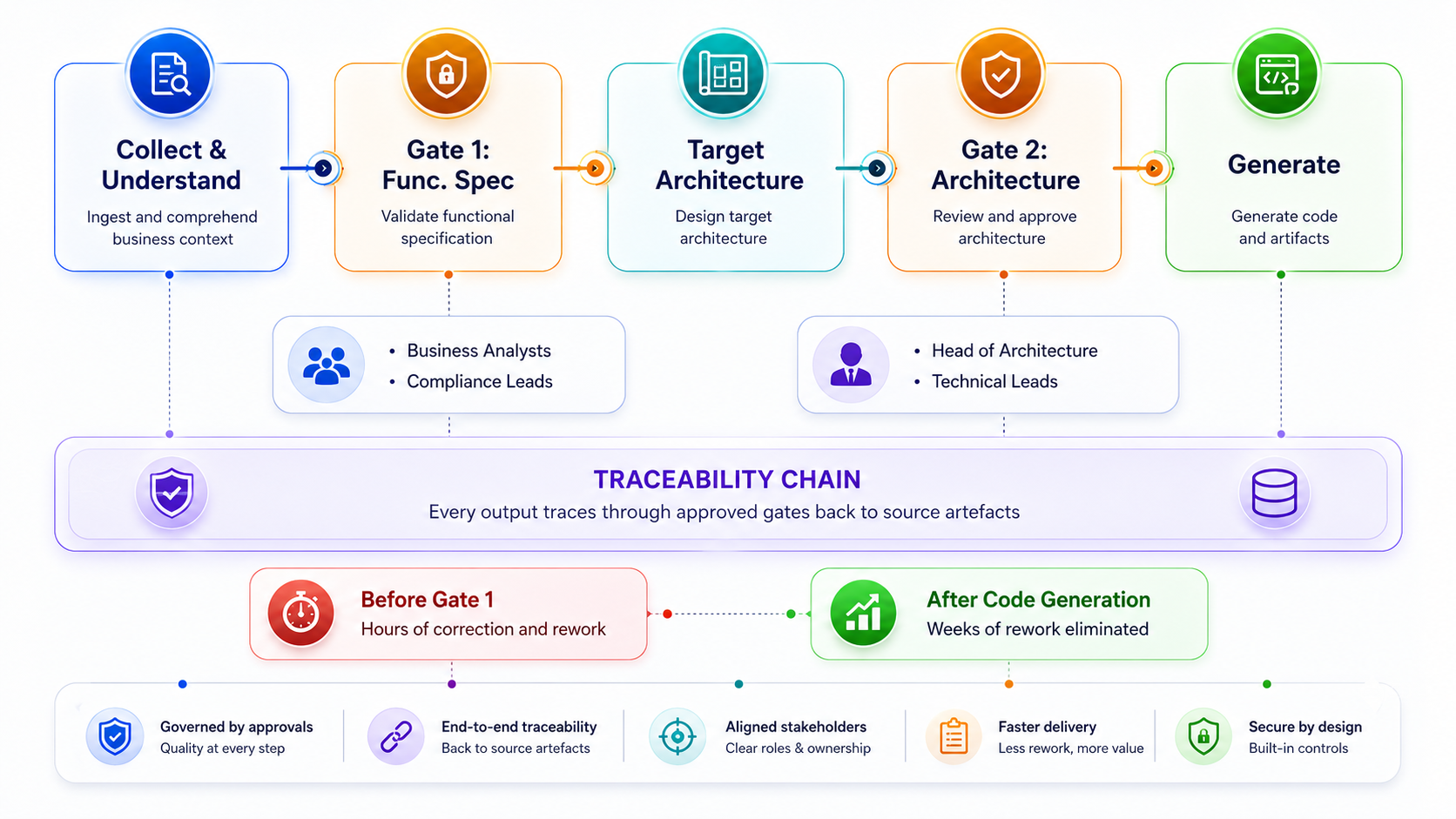
The complete modernization path - from legacy artefacts to deployed application - in a single governed pipeline. Each phase builds on approved outputs from the previous one.

Phase 01
Collect
Phase 02
Understand
Phase 03
Approve
Phase 04
Design
Phase 05
Generate
Artefact inputs
  • Legacy source code - COBOL, .NET, VB6, AS/400, Lotus Notes, C/C++, Delphi, PowerBuilder
  • User interface screens - scraped without source access
  • User manuals, help files, training documents
  • Existing specifications and architecture docs
What happens
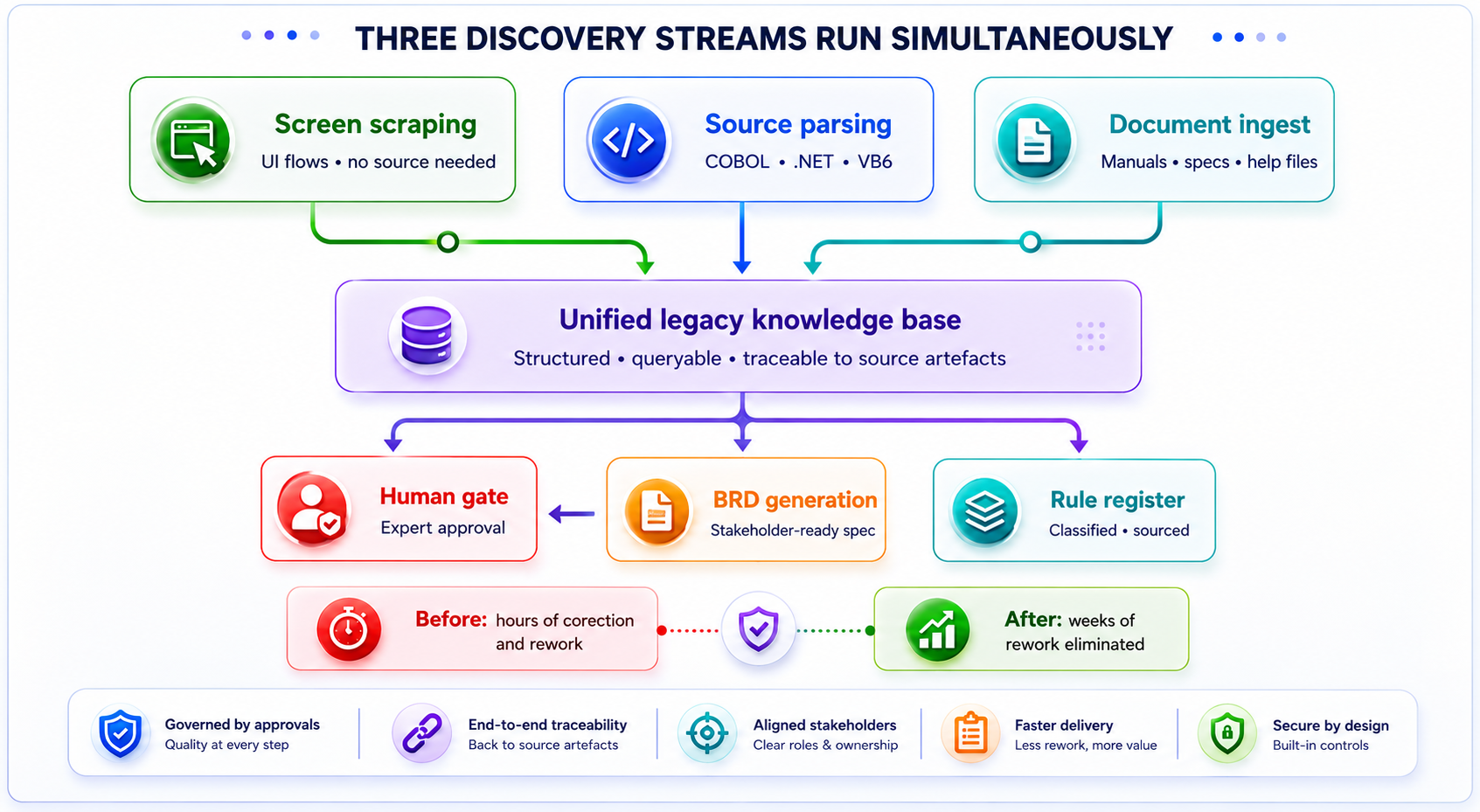
  • All three discovery streams run simultaneously - UI, source, and documentation ingested in parallel
  • Local LLM processes artefacts inside controlled infrastructure - nothing leaves your environment
  • Screen flows, data models, integration points and business logic captured together
Output
  • Unified legacy knowledge base - structured, queryable, traceable to source artefacts
  • Dependency map across all ingested systems
  • Candidate business rule and workflow inventory - ready for expert review in Phase 03
Human-in-the-loop

Expert approval is a core product feature,
not an afterthought.

Modernization succeeds when hidden business knowledge is captured. AdeptRecode.ai keeps experts in the loop at the three moments that matter most.

Gate 1 - After Phase 02
Approve legacy functional artefacts
Before target design begins, application experts review and correct the extracted workflows, business rules and data flows. Errors corrected here cost nothing. Errors discovered after architecture generation cost weeks.
Gate 2 - After Phase 03
Approve technical understanding
Before the component architecture is generated, architects and technical leads validate the data model, integration contracts and dependency map. The target design is built on what was approved - not what was inferred.
Gate 3 - After Phase 04
Approve target design before code generation
The component architecture, API contracts, schema and deployment blueprint are reviewed and signed off before a single line of application code is generated. Code generation is constrained to what was approved. No surprises at delivery.
Why traceability matters

Every decision made at a human approval gate is linked back to the source artefacts that surfaced it. When an auditor asks why a business rule exists, AdeptRecode.ai can trace it - from the generated code, through the approved requirement, back to the original screen or document that captured it.

This isn't a log. It's a governed chain of custody for every business decision in the modernized system.

Approve legacy functional artefacts before target design
Approve technical understanding before architecture generation
Approve target design before application code generation
Keep traceability from every decision back to source artefacts
Target architecture

Built to match each organisation's
engineering standards.

The same modernization engine configured to generate code inside a client's existing framework - improving reuse and reducing long-term maintenance cost.

Input knowledge
What goes in
  • Legacy artefacts - code, screens, manuals, existing specifications
  • Approved functional and technical documentation from human review gates
  • Expert corrections and annotations applied during approval phases
  • Target stack choices - language, framework, BPM engine, deployment model
  • Organisation's existing component library, design system and API conventions
Generation rules
How it's constrained
  • Reference architecture templates - agreed per client before generation begins
  • Coding standards - SOLID, DRY, KISS, Clean Architecture, DDD as applicable
  • Security requirements - OWASP-aligned, SecDevOps pipeline embedded
  • API patterns - OpenAPI, REST, GraphQL conventions standardised across all modules
  • Testing guidelines - E2E, unit, integration and security test coverage strategy
Target outputs
What gets delivered
  • Component architecture - modular, independently deployable, peer-review ready
  • Target functional and technical design documents
  • Database schemas, data migration plan, API contracts
  • Full application code in your chosen stack
  • Test cases - E2E, unit, integration, security - generated in parallel with code
  • Production deployment - the full SDLC is in scope, including go-live
Quality posture
What's guaranteed
  • Maintainability - code that reads like code your team would have written
  • Traceability - every artefact linked to the approved requirement that drove it
  • Security - OWASP-aligned patterns in every module, SAST in every pipeline
  • Reviewability - generated code passes peer review from day one
  • Documentation coverage - BRD, TDD, API docs, data dictionary, runbooks
  • Deployment readiness - CI/CD, environment config, monitoring scaffolding included
Why AdeptRecode.ai

Different from asking Codex, Gemini,
Claude or OpenAI to migrate your code.

Provider coding agents are powerful for developer productivity. AdeptRecode.ai is a governed modernization system - local execution, artefact-first understanding, approval gates and deterministic generation inside approved frameworks.

Direct provider migration - Prompt → generated code
Legacy code and documents may need to be sent to external provider environments unless separately controlled
Output depends heavily on prompts, model behaviour and session context - repeatability varies
Often starts from code conversion before fully documenting workflows, business rules and expert knowledge
Architecture and coding style may drift from organisation frameworks unless manually enforced every time
Review usually happens after code is produced - making corrections costlier
AdeptRecode.ai - Artefacts → approved design → generated app
Uses local LLMs - source code, documents and generated artefacts stay inside controlled infrastructure
Generation constrained by predefined frameworks, templates, standards and target architecture rules
Builds functional and technical understanding from documents, code, manuals and screens first
Customised to your organisation's existing framework - reuse, maintainability and standardisation
Application experts approve artefacts and target design before full code generation begins
Full SDLC coverage

From legacy artefact to production.
AdeptRecode.ai covers the whole journey.

Most modernization tools stop at code generation. AdeptRecode.ai covers the complete software development lifecycle - including deployment into production.

🔍
01
Discovery
UI scraping, source parsing, document ingestion - simultaneous
📋
02
Requirements
BRD, functional spec, business rule register - auto-generated then human-approved
🏗
03
Architecture
Component design, API contracts, schema, BPM engine - after expert sign-off
⌨️
04
Development
Deterministic code generation inside approved frameworks and component library
🧪
05
Testing
E2E, unit, integration and security tests generated in parallel with code
🔐
06
Security
OWASP-aligned patterns, SAST, SCA and SecDevOps pipeline - built in from day one
🚀
07
Deployment
CI/CD pipeline, container configs, environment strategy, monitoring - production-ready
📄
08
Documentation
API docs, data dictionaries, architecture diagrams, audit trail, compliance package
Component library approach

Before we generate one line,
we define every pattern you'll use.

"The client's framework shouldn't adapt to the tool. The tool should adapt to the client's framework."

Before code generation begins, AdeptRecode.ai works with your architects to assemble a client-specific component library - the reusable building blocks from which every generated module is constructed. Naming conventions, folder structures, API contracts, error handling patterns, logging standards, authentication flows, security patterns and UI design tokens: all agreed and encoded before the AI writes a single class.

The result is a modernized codebase your engineers can navigate, extend and maintain immediately - because it looks like code they would have written themselves. Only faster, more complete, more secure, and fully tested.

AdeptRecode.ai can still use strong coding models internally where approved. The product value is the governed migration process around the model - local privacy, traceability, deterministic scaffolding and human approval gates.

📐
Architecture patterns
Clean architecture, SOLID, DDD - agreed before generation
Client-configured
🔌
API contracts
OpenAPI specs, endpoint naming, versioning - standardised
Auto-generated
🔐
Secure coding patterns
OWASP-aligned, auth scaffolding, audit logging - every module
OWASP aligned
⚙️
Open-source BPM
Camunda, Flowable or jBPM - governed process definitions
Open-source
🛡
SecDevOps pipeline
SAST, SCA, secret scanning - built into CI/CD from day one
SecDevOps
📊
Data layer standards
ORM patterns, migration scripts, data dictionary - auto-documented
Auto-generated
Who we work with

For the people responsible
for systems they didn't build.

Every person here inherited a problem they didn’t create. AdeptRecode.ai gives them a governed path forward.

C
CTO / CIO
“I can’t afford another 18-month project that delivers the wrong thing.”
Modernize without betting the company on it — documented, tested, client-standard output from day one.
V
VP Engineering
“Half our capacity goes to working around the old system.”
Clear the runway with clean APIs, tested services, and architecture your team can own.
A
Head of Architecture
“I need to own the output, not just receive it.”
Define the target architecture before generation begins, with every module conforming to your patterns.
R
Compliance / Risk
“We can’t prove the system does what we think it does.”
Get traceability, audit trails, and business rule provenance generated as part of the process.
T
Transformation Consultant
“I need a differentiated offer before competitors build one.”
Bring clients an AI engine that slots into your engagement model and strengthens your modernization offer.
P
Programme Director
“We’re 18 months in and still finding things out of scope.”
Ground scope in requirements extracted from the real system before build begins.
Industries & stacks

Built for sectors where the
stakes are too high to guess.

Banking
Banking & Financial Services
Government
Government & Public Sector
Healthcare
Healthcare & Life Sciences
Energy
Utilities & Energy
Telecommunications
Telecommunications
Insurance
Insurance
Legacy stacks we read
COBOL COBOL
C++ C / C++
Delphi Delphi
.NET .NET Framework
VB6 VB6 / VBA
ASP ASP Classic
IBM AS/400
Lotus Notes Lotus Notes
Java Legacy Java 8
PowerBuilder PowerBuilder
COBOL COBOL
C++ C / C++
Delphi Delphi
.NET .NET Framework
Modern targets we build to
.NET .NET 8
React React + TypeScript
Python Python 3
Node Node.js
Spring Spring Boot
Java Java 21
Microservices Microservices
GraphQL REST / GraphQL
Camunda Camunda BPM
Flowable Flowable / jBPM
.NET .NET 8
React React + TypeScript
Python Python 3
Node Node.js
Get started

Four weeks.
A real system.
No guesswork.

Not a demo environment. A working proof-of-concept on an actual legacy codebase - with human-reviewed requirements before a single line of code is generated.

1
Scope and NDA. One application or module. Measurable success criteria agreed together. Target stack, compliance requirements and BPM needs defined. Component library configured to your standards.
2
Discovery and approved BRD. All three discovery inputs run simultaneously. BRD, functional spec and business rule register generated - then reviewed and signed off by your team before build begins.
3
Architecture sign-off. Component architecture, API contracts and deployment blueprint reviewed by your architects. Approved before a single line of application code is written.
4
Parallel generation and delivery. Code and test suite generated simultaneously from the approved BRD. Full codebase, Playwright suite, SecDevOps pipeline and traceability matrix - in your target language, to your standards. Yours to keep.